Quezon City, Philippines — Marinduque State University (MarSU) and the Philippine Space Agency (PhilSA) have strengthened their commitment to advancing space-enabled education, research, and innovation through the ceremonial signing of a Memorandum of Agreement (MOA) under the PhilSA Integrated Network for Space-Enabled Actions towards Sustainability (PINAS) Academe.
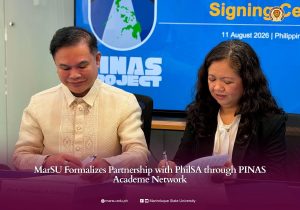
Held at the PhilSA Conference Room, 29F Cyber One Building, Eastwood Avenue, Bagumbayan, Quezon City, the signing brought together MarSU and other Philippine higher education institutions as their university presidents and representatives formalized their respective partnerships with PhilSA. The activity formed part of the PINAS Academe for Space Science, Technology, and Applications (SSTA) Training held on August 11–12, 2026.
The MOA signing was facilitated by PhilSA and the MarSU International Relations and Linkages Office (IRLO).
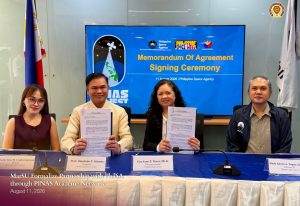
Representing PhilSA in the signing was Director General Dr. Gay Jane P. Perez, while MarSU University President Prof. Dr. Diosdado P. Zulueta represented the University. The ceremony was witnessed by IRLO Director A/Prof. Jholey Rose R. Leaño-Lancion and Dr. Mark Edwin A. Tupas, Director IV for the Space Information Infrastructure Bureau of PhilSA.
The signing followed the presentation and overview of the PINAS Academe MOAs and was followed by the exchange of tokens, photo opportunity, and discussions on the next steps and ways forward for the partnerships.
For MarSU, the partnership is part of the University’s continuing push for meaningful collaborations that expand opportunities for its students, faculty, researchers, and communities. It also supports the Empower2Achieve Agenda of MarSU President Prof. Dr. Zulueta, complementing the national higher education direction of the Commission on Higher Education (CHED) through its ACHIEVE Agenda.
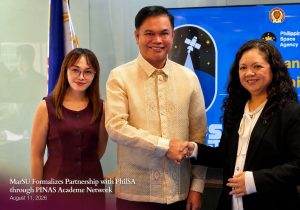
More importantly, the partnership opens doors for several areas of collaboration, particularly in instruction, research, and community engagement. Through the use of Space Science, Technology, and Applications (SSTA), these collaborations may support initiatives in disaster management, agriculture, environmental management, land and resource monitoring, and other relevant fields where space-based data and technologies can contribute to informed decision-making and sustainable development.
The partnership also provides opportunities for MarSU to further connect classroom learning and academic programs with emerging technologies, while giving faculty and researchers avenues to explore space-enabled research and applications that respond to actual community needs.
The PINAS Academe program itself includes activities on DATOS projects and remote sensing, followed by hands-on space-data processing using JuanMap, SAKA, OpERA, and DHARMA—tools and applications that can help build institutional capacity for future research, planning, and community-based initiatives.
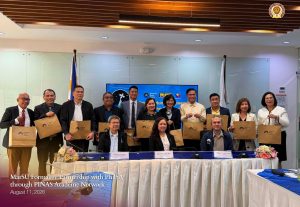
More than a ceremonial signing, the gathering marked a shared commitment among Philippine higher education institutions and PhilSA to put knowledge, technology, and space-based information to work for communities.
As MarSU continues to build partnerships From the Heart, to the World, the University looks toward translating these collaborations into opportunities that empower its people and contribute to the Sustainable Development Goals.
#MarSU #PhilSA #PINASAcademe #Empower2Achieve #ACHIEVEAgenda #SSTA #SpaceForDevelopment #SDG4 #SDG9 #SDG11 #SDG13 #SDG17 #FromTheHeartToTheWorld